According to the game's definition of a regular Fayth (separate from the final Aeon's Fayth), a Fayth is an original survivor of Zanarkand, destroyed one thousand years ago, who goes into a dreaming sleep. This now Fayth's dream creates the Aeon, which is a personification of the dreamer.
Anima is the only Aeon of whom we actually learn something about her real waking life. She was the wife of Lord Jyscal, and the mother of Maester Seymour. She gave up her life to become a Fayth in order to help her son bring the calm. (To be able to do this, she must have been a survivor of Zanarkand.) Yet, this action did not help her son at all. What total effect this action had on Seymour was immeasurable. He became bent on death and destruction and claimed that Spira was nothing more than a spiral of death. One can only imagine a mother's pain upon seeing her child give up on hope, and become pure evil.
Anima Sola is possibly a Catholic or another Mexican religious icon. Anima Sola (Italian for Lonely Soul) is usually pictured as a woman in chains burning in the purging flames of purgatory. She/he is prevalent in Mexican folk art, especially in carved wooden figurines. It is also said that one can
pray to her for the easing of a loved one's sufferings in purgatory or for the intensifying of an enemy's pain in purgatory.
The Aeon Anima is obviously a version of Anima Sola. When summoning Anima, a large hook pulls her up from the depths of the earth, as if from purgatory, and she is wrapped and bound in chains. Around her neck hangs an image similar to those of Anima Sola herself, almost as if to point out the connection between the two.
Anima's attack called Pain seems to echo the themes of the Fayth's personal torment and Anima Sola's pain in purgatory. Or it could be a taste of the pain to come in purgatory.
Oblivion, as defined in the dictionary, means an act of or instance of forgetting, or official ignoring of offenses; Pardon. Yet Anima's overdrive Oblivion seems to symbolize eternal damnation, or
increased suffering in purgatory. These meanings seem contradictory. Perhaps iti s supposed to speak of Anima's pardon? But either way it is taken, both meanings link Anima to Anima Sola.
Seymour's mother's inescapable chains, her hideous pain and possibly even her condemnation, and Anima Sola's shackles, pain and suffering are similar. They are both women bound by what they have done. They are both tortured, and much pained in heart.


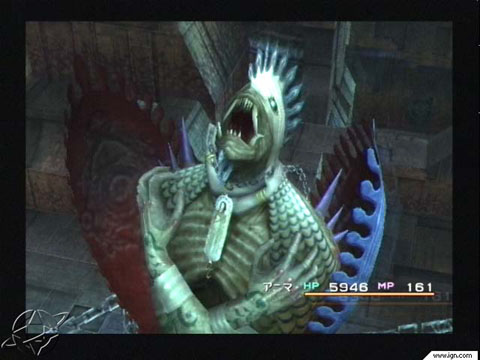 Anima, the mother of Seymour and tormented soul